December 9, 2011

X-RAYS -genesis-


X-rays play a very important role in many fields, especially in medicine. X-ray images of internal organs are used extensively in medicine as a diagnostic tool. An X-ray technique called computer-assisted tomography (CAT) enables a clearer view of the structure of any part of the body without any need for surgery.

X-rays are a form of electromagnetic radiation. The wavelength of X-rays are in the range of .01 to 10 nanometers. Shorter than UV rays, longer than gamma rays. X-rays are also classified into two classes, 'soft' x-rays and 'hard' x-rays respectively.

Needless to say, hard x-rays have greater penetrating power. That's the only major distinguishing factor.

So...

X-rays. What do you know about them? Nothing? How are they produced?

We're going to paint a basic picture about the production of x-rays.
Literally.

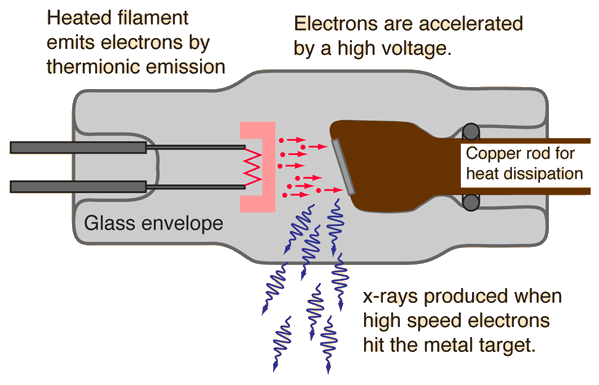
Electrons are emitted through thermionic emissions when the filament is heated by current flowing in it. The electrons are accelerated towards the copper anode by the high potential difference ranging from 10^4 V to 10^6 V between the anode and the cathode.

The glass tube is evacuated so that the electrons are pulled towards the anode at a very high speed without colliding with air molecules.

The electrons decelerate rapidly on impact with the target. As a result, some of the kinetic energy is converted into X-rays. Less than 1% of the total energy supplied to the X-ray tube is converted into X-rays, the remainder is released as heat.

So inefficient.

The target metal must be made of heavy metals with a high melting point such as molybdenum or tungsten, to prevent the target from melting easily.


X-rays of short wavelength and high penetrating power are called HARD X-rays. X-rays of long wavelength and low penetrating power are called SOFT X-rays.

Minimum wavelength,  λmin = hc/eV


December 3, 2011

Laser -Degree-


Previously in our online 'course', we discussed about the basic principle of the laser technology. With the limited information provided, surely you must have come to a conclusion that stimulated emission is simply not sustainable without sufficient excited atoms.

And you may also have deduced that to achieve the required number of excited atoms is pretty complicated.

This is where population inversion comes into play. 


See, in lasers, light emission by stimulated emission occurs more than by spontaneous emission. To achieve this state, the number of atoms at high-energy levels must exceed the number of atoms at ground state. 

This situation is known as population inversion. To make population state possible, a state called metastable state is created. In the metastable state, the atom remains in the excited state a little longer than usual.

Which brings us to an example:

The Helium-Neon Laser.


A mixture of helium and neon gas in the ratio of 20:80 is contained in a tube with mirrors at both end. When a potential difference (Voltage) is applied across the tube, electrons will travel along it. 

Refer to the below diagram if you aren't a university graduate who probably should already know all this stuff.
Laser technology is taught even in the very basic of physics university courses.


Electrons colliding with the helium atoms cause them to be raised to energy level E2 (20.61eV). This value is close to the energy level of neon E4(20.66eV).

Collisions between the helium and neon atoms enables the neon atoms to attain energy level E4 easily, hence, the number of neon atoms at E4 is more than the number of neon atoms at E1.

And we have a Population Inversion.

Which brings us back to our previous course: 

The combination of all of this results in a highly coherent, intense beam of light.


December 1, 2011

Laser


LASER is an acronym for Light Amplification by Stimulated Emission of Radiation.

Laser is a technology of paramount importance to the prosperity of mankind. As verbose as the previous sentence sounds, it is indeed the best way to rank the significance of the technology. Lasers are used in varying fields, ranging from laser hair removal and laser surgery to instrument calibration. 

As such, I believe that all of us should know the basic principles of laser production. Under any circumstances should you find yourself requiring a laser hair removal expert, you can rest at peace with the principles of laser production firmly in mind. It's not much, but it could prove to be a hell of an icebreaker with that pretty surgeon that you had your eyes on.

Without further ado:
Picture Unrelated
The principles of laser production are:
-Stimulated Emission
-Metastable State
-Population Inversion
-Light Amplification

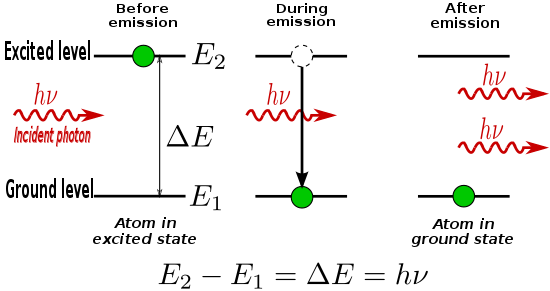
Stimulated emission is the emission of a photon from an excited atom by another photon of the exact same frequency. Both of the photons are coherent. 

image from wikipedia.org


Light amplification is the process in which one photon stimulates the emission of another proton of the same frequency. The two photons then stimulate the emission of two other photons. 
Think: 'Chain Reaction + Stimulated Emission'.


The chain reaction results in a burst of photons, all in phase, monochromatic(same frequency), and highly coherent. Constructive superposition of said waves produce a beam of high intensity. 

And that, is the basic idea of laser. More to come in a future post, wouldn't want to overload you with too much information.


EDIT: This post is apparently very popular in the general location of NYC, famous for cheap laser hair removal. NYC will then have gained a little knowledge of lasers. I flatter myself.